Showing posts with label World. Show all posts

Inspirational tattoos

Now that we have discovered the motivation of foot tattoo designs for women,... one thing left to do; wear your new sexy foot tattoo well and don't cover it up, ...Inspirational Words for Tattoos.


 Inspirational tattoos


 Inspirational tattoos


 Inspirational tattoos


 Inspirational tattoos


 Inspirational tattoos


 Inspirational tattoos


 Inspirational tattoos


 Inspirational tattoos


 Inspirational tattoos


 Inspirational tattoos


 Inspirational tattoos


World's Most Important Spice-Pepper


Pepper
, common name for a family comprising a medium-size group of shrubby or herbaceous flowering plants, and for its representative genus. The family contains between 5 and 10 genera and about 2000 species. Pantropical in distribution, it is particularly abundant in moist areas. Other than the representative genus, the only economically important member of the family is a genus sometimes called pepper elder. An ornamental plant, it is grown in greenhouses.
pepper_www.wonders-world.com_13
Pepper, the world's most important spice , is prepared from the peppercorn, the fruit of the pepper plant, a climbing vine native to India and widely cultivated in hot, moist areas of tropical Asia. Peppercorns that are harvested while green and immature and then allowed to dry yield black pepper. To produce white pepper, red and ripe peppercorns are soaked in water and their outer covering is rubbed off. Pepper is one of the oldest known spices, in use for at least 3000 years. Although pepper contains several alkaloids, its pungency is caused by a resin, chavicine. Chili and sweet peppers are derived from plants of the nightshade family.
985chilly_pepper
The popular Polynesian beverage kava is produced from the roots of a shrub, which are mashed and fermented in water. The active ingredient is not alcohol, but an alkaloid.
pepper_www.wonders-world.com_09
The pepper family is the largest of three in its order. The flowers of the order are small and borne in spikes that are subtended by bracts. Neither sepals nor petals are present; a single superior ovary is borne free from other flower parts. Stamens (male floral structures) vary in number from one to ten. The fruits are often single-seeded, such as the familiar peppercorn.
pepper_www.wonders-world.com_10
The lizard's-tail family, in the same order as the pepper family, occurs in eastern Asia and North America and consists of fewer than ten species in five genera, most of which are found in moist habitats. Unlike the peppers, the bracts below the flower spike are colored and showy. A few species are cultivated as ground cover or in bog gardens, and the western North American yerba mansa has been used medicinally. The other family in the order, the chloranthus family, with about 5 genera and 75 species of tropical trees, shrubs, and herbs, is a taxonomically isolated group sometimes placed in its own order. Although disparate in the order in terms of anatomical features, the family shares the reduced floral characters and presence of oil cells with the other two families. Some recent classification systems place the pepper elders in a separate family of the order.
Scientific classification: Peppers make up the family Piperaceae of the order Piperales. Its representative genus is Piper. Pepper elders constitute the genus Peperomia. The pepper plant is classified as Piper nigrum. Chili and sweet peppers are derived from plants of the genus Capsicum, of the family Solanaceae. The Polynesian beverage kava is produced from the plant classified as Piper methysticum. The lizard's-tail family is Saururaceae. The yerba mansa is classified as Anemopsis californica. The other family in the order Piperales is Chloranthaceae.

Prometheus Young Man Of 5000 Years


Prometheus was a member of a population of bristlecone pine trees growing near tree line on the lateral moraine of a former glacier on Wheeler Peak, in what, since 1986, has been Great Basin National Park, in eastern Nevada. Wheeler Peak is the highest mountain in the Snake Range, and the highest mountain entirely within the state of Nevada. The bristlecone pine population on it is divided into (at least) two distinct sub-populations, one of which is accessible by a popular interpretive trail. Prometheus however, grew in an area reachable only by off-trail hiking. In either 1958 or 1961, a group of naturalists who admired the grove in which the tree grew gave names to a number of the largest or most distinctive trees, including Prometheus.


Currey originally aged the tree at, minimally, 4844 years. A few years later, this was increased to 4862 by Donald Graybill of the University of Arizona's Laboratory of Tree-Ring Research. However, these ring counts were done on a trunk cross section taken about 2.5 m (8 feet) above the original germination point of the tree, because the innermost rings were missing below that point. Adjusting Graybill's figure of 4862 by adding in the estimated number of years required to reach this height, plus a correction for the estimated number of missing rings (which are not uncommon in trees growing at tree line), it is probable that the tree was at least 5000 years old when felled. This makes it the oldest unitary (i.e non-clonal) organism ever discovered, exceeding the Methuselah tree of the White Mountains' Schulman Grove, in California by two to three hundred years.


Whether Prometheus should be considered the oldest organism ever known depends on the definition of "oldest" and "organism". Certain sprouting (clonal) organisms, such as creosote bush or aspen, may have older individuals if the entire clonal organism is considered. Under this standard, the oldest living organism is a quaking aspen grove in Utah known as Pando, at perhaps as much as 80,000 years old. However, in a clonal organism the individual clonal stems are nowhere near as old, and no part of the organism at any given point in time is particularly old. Prometheus was thus the oldest non-clonal organism yet discovered, with its innermost, extant rings exceeding 4862 years of age.


Olive Fruit Facts


Olive, common name for a plant family , and for its representative genus, and for the fruit of the olive tree. The family contains about 900 species, placed in 24 genera. It comprises a small group of woody flowering plants, of almost cosmopolitan distribution, that contains several plants of horticultural and economic importance. In addition to the olive, familiar members of the family include ash, lilac, privet, jasmine, forsythia, and the fringe tree.


Most members of this family of dicots are shrubs or small trees, although a few are climbers. Nearly all have opposite leaves, which may be simple, as in lilacs and forsythias, or compound (composed of several separate leaflets), as in ashes. Flower structure is rather uniform in the family, but some variation occurs. Typically, flowers have four sepals (outer floral whorls) and four petals (inner floral whorls), two stamens (male flower parts) attached to the inner surface of the petals, and a single ovary (female flower part), which is superior (borne above and free from other flower parts). The fruits, which develop from the ovary after fertilization, vary considerably but usually contain a single seed. Examples of distinctive fruits include those of the olive, which are technically drupes (hard seeds surrounded by fleshy material); those of the ashes, which are indehiscent (remain closed at maturity) and winged and are technically known as samaras; and those of the lilacs, which are dry and dehiscent (splitting at maturity).


The olive genus contains about 20 species and is widespread in Eurasia. A few species produce good timber—for example, the black ironwood, of southern Africa. The cultivated olive is originally native to the eastern Mediterranean region but now widely cultivated throughout that area and in other parts of the world that have Mediterranean-type climates. The olive is cultivated for its fruits, which yield an edible oil and are also pickled for eating. Olive oil, which is derived from fresh, ripe fruits that contain about 20 percent oil, is used in cooking, in canning, and as a table oil. Olives for eating are picked either when unripe or when ripe. Unripe olives are green and remain so during pickling. Ripe olives are dark bluish when fresh and turn blackish during pickling. The seed, or stone, of the olive is often removed and the cavity stuffed with spicy materials such as sweet red pepper. The wood of the cultivated olive, being hard and variegated, is valued in cabinetry.


Scientific classification: Olives make up the family Oleaceae. The representative genus is Olea. The black ironwood is classified as Olea laurifolia and the cultivated olive as Olea europaea.


Most Extraordinary Churches of the World

1. Church of St. George(Lalibela, Ethiopia)
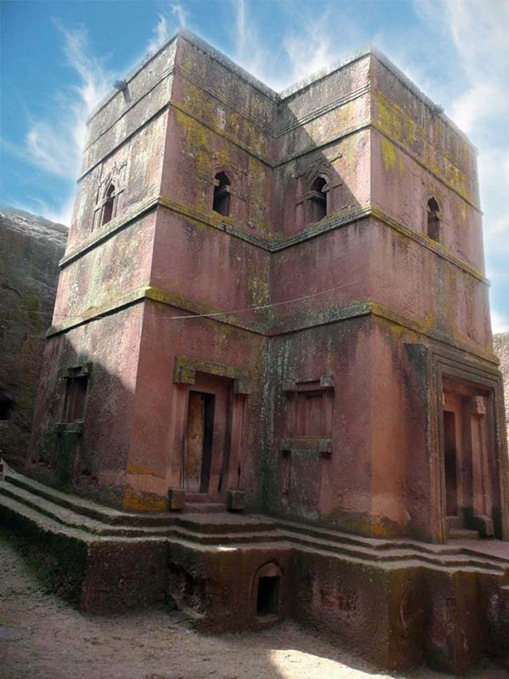
Church of St. George

Church of St. George

Possibly the most famous of Lalibeli’s churches, the Church of St. George is completely carved out of stone in the shape of a cross.

2. Trendsetters Church (Phoenix, AZ, USA)

Trendsetters Church

Trendsetters Church in Phoenix, AZ, built in 1973 by Neil Frisby as Capstone Cathedral. I’m sure Neil Frisby visited Egypt just before designing this church.

3. Chapel in the Rock (Arizona, USA)

Chapel in the Rock

This facinating Roman Catholic church is literally built into the rock. The views from outside are unbelievable but the serenity inside is awesome

Some say, that Chapel in the Rock can move even the non-religious.

4. The Wireman Chapel at Eckerd College (St. Petersburg, Florida, USA)

The Wireman Chapel at Eckerd College

A kid on the tour to Eckerd College once said it looked like a “Jesus spider from outer space.” Inspired by 20th-century architect

Eero Saarinen, the Chapel was designed by the highly respected Chicago architectural firm of Perkins and Will. Its key design features are its octagonal shape and in-the-round seating, the oculus at the center of the roof that directs sunlight to the center of the sanctuary, the lower glass panels which reflect light from the water outside to the interior, and the girders which recall the flying buttresses of the medieval cathedral, instilling a sense of timelessness in a contemporary structure.

5. Saint-Michel d’Aiguilhe chapel (Le Puy-en-Velay, France)

Saint-Michel d’Aiguilhe chapel

Perhaps one of the most remarkable sights in France, a chapel perched on a volcanic plug. This is the Rock of Aiguilhe, on the edge of the town of Puy en Velay, in the Auvergne. The Chapelle Saint-Michel has stood there for 1042 years, since Bishop Gothescalk had it built in 962 on his return from a pilgrimage to Santiago del Compostella in Galicia. In 1955 workers found relics under the alter that had been there since it was built.

6.The Chapel on the Rock (Allenspark, Colorado, USA)
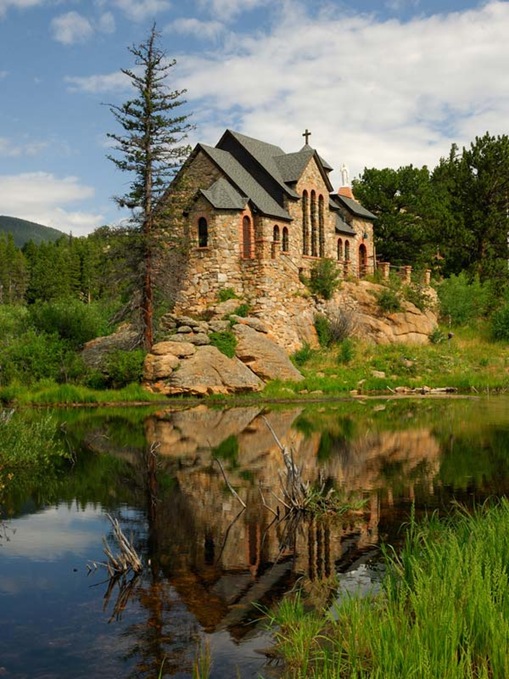
The Chapel on the Rock

The founder of Camp St. Malo, Monsignor Joseph Bosetti, had for years entertained an idea that one day he would build a chapel on this site. In 1916 he and two friends observed a falling meteor during the night and in his search for the remnants the next morning, he came across a large rock. The beauty of the land inspired the priest and he remembered Jesus’ words to Peter: “Upon this rock, I will build my Church.” (Matt 16:18).

Vowing one day to build a chapel here, Msgr. Bosetti prayed for nearly 20 years to acquire the funds. During time, he found himself in a constant battle with the Colorado Highway department which had plans to dynamite the enormous piece of granite to both widen and straighten the curve in the road.

Eventually, Msgr. Bosetti won the battle and years later, when the chapel became a reality, it was reported that a group of engineers who laid out the road came to the dedication and thanked him for his perseverance.

The chapel was designed by noted Denver architect Jacques Benedict.

In 1993, Pope John Paul II visited the chapel during his trip to Denver for the World Youth Day and bestowed his personal blessing on the chapel.

7. Cadet Chapel (Air Force Academy, Colorado, USA)

Cadet Chapel

The United States Air Force Academy Cadet Chapel, completed in 1962, is the distinguishing feature of the Cadet Area at the United States Air Force Academy. It was designed by renowned architect Walter Netsch of Skidmore, Owings and Merrill of Chicago. Originally controversial in its design, the Cadet Chapel has become a classic and highly regarded example of modernist architecture. The Cadet Chapel was awarded the American Institute of Architects’ National 25 Year Award in 1996, and as part of the Cadet Area, was named a U.S. National Historic Landmark in 2004.

8.St. Augustine Church (Brookland, Kent, UK)

St. Augustine Church

“Yes the late 12th century, wooden, bell tower is separate from the rest of the church! Apparently it is the only one of its size and shape in the country. Originally it was open to the elements the cladding being addedin the 15th century. You almost can’t take a picture of this lovely church without getting that litter bin or telephone wires (or both) in frame; the litter bin is even in all the guide books!”

More info: here

9. The Church of Hallgrímur (Reykjavík, Iceland)

The Church of Hallgrímur

The Church of Hallgrímur is a Lutheran parish church which is also a very tall one, reaching 74.5 meters (244 ft) height. It is the fourth tallest architectural structure in Iceland.

It took incredibly long to build it (38 years!) Construction work began in 1945 and ended in 1986.

Architect: Guðjón Samúelssondesign.

More info: Hallgrímskirkja

10. Las Lajas Cathedral (Colombia, South America)

Las Lajas Cathedral

Las Lajas Cathedral was built in 1916 inside the canyon of the Guaitara river where, according to local legend, the Virgin Mary appeared.

You can find it in southern Colombian Department of Nariño, municipality of Ipiales, near the border with Ecuador.

11. Device to Root Out Evil (Calgary, AB, Canada)

Device to Root Out Evil

It was too hot for New York City; too hot for Stanford University. But a controversial, imposing sculpture by renowned international artist Dennis Oppenheim finally found a public home in laid-back Vancouver.

A country church is seen balancing on it’s steeple, as if it had been lifted by a terrific force and brought to the site as a device or method of rooting out evil forces.

12. Chapel of St. Gildas (Brittany, France)

Chapel of St. Gildas

Mads: “This is the chapel of St-Gildas, which sits upon the bank of the Canal du Blavet in Brittany, France. “Built like a stone barn into the base of a bare rocky cliff, this was once a holy place of the Druids. Gildas appears to have travelled widely throughout the Celtic world of Corwall, Wales, Ireland and Scotland. He arrived in Brittany in about AD 540 and is said to have preached Christianity to the people from a rough pulpit, now contained within the chapel.” (from ‘Cruising French Waterways’ by Hugh McKnight p.150)”

13. St Joseph Ukrainian Catholic Church (Chicago, IL, USA)

St Joseph Ukrainian Catholic Church

It’s massiveness and gray color looks like Soviet architecture. I was amazed when I read that it was actually in USA and not in Soviet Union.

St. Joseph Ukrainian Catholic church is best known for its ultra-modern thirteen gold domed roof symbolizing the twelve apostles and Jesus Christ as the largest center dome.

It is celebrating its 53 years, so it was built in 1956 (if panda’s calculations are right).

Most Extraordinary Churches of the World

1. Church of St. George(Lalibela, Ethiopia)

Church of St. George

Church of St. George

Possibly the most famous of Lalibeli’s churches, the Church of St. George is completely carved out of stone in the shape of a cross.

2. Trendsetters Church (Phoenix, AZ, USA)

Trendsetters Church

Trendsetters Church in Phoenix, AZ, built in 1973 by Neil Frisby as Capstone Cathedral. I’m sure Neil Frisby visited Egypt just before designing this church.

3. Chapel in the Rock (Arizona, USA)

Chapel in the Rock

This facinating Roman Catholic church is literally built into the rock. The views from outside are unbelievable but the serenity inside is awesome

Some say, that Chapel in the Rock can move even the non-religious.

4. The Wireman Chapel at Eckerd College (St. Petersburg, Florida, USA)

The Wireman Chapel at Eckerd College

A kid on the tour to Eckerd College once said it looked like a “Jesus spider from outer space.” Inspired by 20th-century architect

Eero Saarinen, the Chapel was designed by the highly respected Chicago architectural firm of Perkins and Will. Its key design features are its octagonal shape and in-the-round seating, the oculus at the center of the roof that directs sunlight to the center of the sanctuary, the lower glass panels which reflect light from the water outside to the interior, and the girders which recall the flying buttresses of the medieval cathedral, instilling a sense of timelessness in a contemporary structure.

5. Saint-Michel d’Aiguilhe chapel (Le Puy-en-Velay, France)

Saint-Michel d’Aiguilhe chapel

Perhaps one of the most remarkable sights in France, a chapel perched on a volcanic plug. This is the Rock of Aiguilhe, on the edge of the town of Puy en Velay, in the Auvergne. The Chapelle Saint-Michel has stood there for 1042 years, since Bishop Gothescalk had it built in 962 on his return from a pilgrimage to Santiago del Compostella in Galicia. In 1955 workers found relics under the alter that had been there since it was built.

6.The Chapel on the Rock (Allenspark, Colorado, USA)

The Chapel on the Rock

The founder of Camp St. Malo, Monsignor Joseph Bosetti, had for years entertained an idea that one day he would build a chapel on this site. In 1916 he and two friends observed a falling meteor during the night and in his search for the remnants the next morning, he came across a large rock. The beauty of the land inspired the priest and he remembered Jesus’ words to Peter: “Upon this rock, I will build my Church.” (Matt 16:18).

Vowing one day to build a chapel here, Msgr. Bosetti prayed for nearly 20 years to acquire the funds. During time, he found himself in a constant battle with the Colorado Highway department which had plans to dynamite the enormous piece of granite to both widen and straighten the curve in the road.

Eventually, Msgr. Bosetti won the battle and years later, when the chapel became a reality, it was reported that a group of engineers who laid out the road came to the dedication and thanked him for his perseverance.

The chapel was designed by noted Denver architect Jacques Benedict.

In 1993, Pope John Paul II visited the chapel during his trip to Denver for the World Youth Day and bestowed his personal blessing on the chapel.

7. Cadet Chapel (Air Force Academy, Colorado, USA)

Cadet Chapel

The United States Air Force Academy Cadet Chapel, completed in 1962, is the distinguishing feature of the Cadet Area at the United States Air Force Academy. It was designed by renowned architect Walter Netsch of Skidmore, Owings and Merrill of Chicago. Originally controversial in its design, the Cadet Chapel has become a classic and highly regarded example of modernist architecture. The Cadet Chapel was awarded the American Institute of Architects’ National 25 Year Award in 1996, and as part of the Cadet Area, was named a U.S. National Historic Landmark in 2004.

8.St. Augustine Church (Brookland, Kent, UK)

St. Augustine Church

“Yes the late 12th century, wooden, bell tower is separate from the rest of the church! Apparently it is the only one of its size and shape in the country. Originally it was open to the elements the cladding being addedin the 15th century. You almost can’t take a picture of this lovely church without getting that litter bin or telephone wires (or both) in frame; the litter bin is even in all the guide books!”

More info: here

9. The Church of Hallgrímur (Reykjavík, Iceland)

The Church of Hallgrímur

The Church of Hallgrímur is a Lutheran parish church which is also a very tall one, reaching 74.5 meters (244 ft) height. It is the fourth tallest architectural structure in Iceland.

It took incredibly long to build it (38 years!) Construction work began in 1945 and ended in 1986.

Architect: Guðjón Samúelssondesign.

More info: Hallgrímskirkja

10. Las Lajas Cathedral (Colombia, South America)

Las Lajas Cathedral

Las Lajas Cathedral was built in 1916 inside the canyon of the Guaitara river where, according to local legend, the Virgin Mary appeared.

You can find it in southern Colombian Department of Nariño, municipality of Ipiales, near the border with Ecuador.

11. Device to Root Out Evil (Calgary, AB, Canada)

Device to Root Out Evil

It was too hot for New York City; too hot for Stanford University. But a controversial, imposing sculpture by renowned international artist Dennis Oppenheim finally found a public home in laid-back Vancouver.

A country church is seen balancing on it’s steeple, as if it had been lifted by a terrific force and brought to the site as a device or method of rooting out evil forces.

12. Chapel of St. Gildas (Brittany, France)

Chapel of St. Gildas

Mads: “This is the chapel of St-Gildas, which sits upon the bank of the Canal du Blavet in Brittany, France. “Built like a stone barn into the base of a bare rocky cliff, this was once a holy place of the Druids. Gildas appears to have travelled widely throughout the Celtic world of Corwall, Wales, Ireland and Scotland. He arrived in Brittany in about AD 540 and is said to have preached Christianity to the people from a rough pulpit, now contained within the chapel.” (from ‘Cruising French Waterways’ by Hugh McKnight p.150)”

13. St Joseph Ukrainian Catholic Church (Chicago, IL, USA)

St Joseph Ukrainian Catholic Church

It’s massiveness and gray color looks like Soviet architecture. I was amazed when I read that it was actually in USA and not in Soviet Union.

St. Joseph Ukrainian Catholic church is best known for its ultra-modern thirteen gold domed roof symbolizing the twelve apostles and Jesus Christ as the largest center dome.

It is celebrating its 53 years, so it was built in 1956 (if panda’s calculations are right).

Related Posts Plugin for WordPress, Blogger...